
October 22, 2026
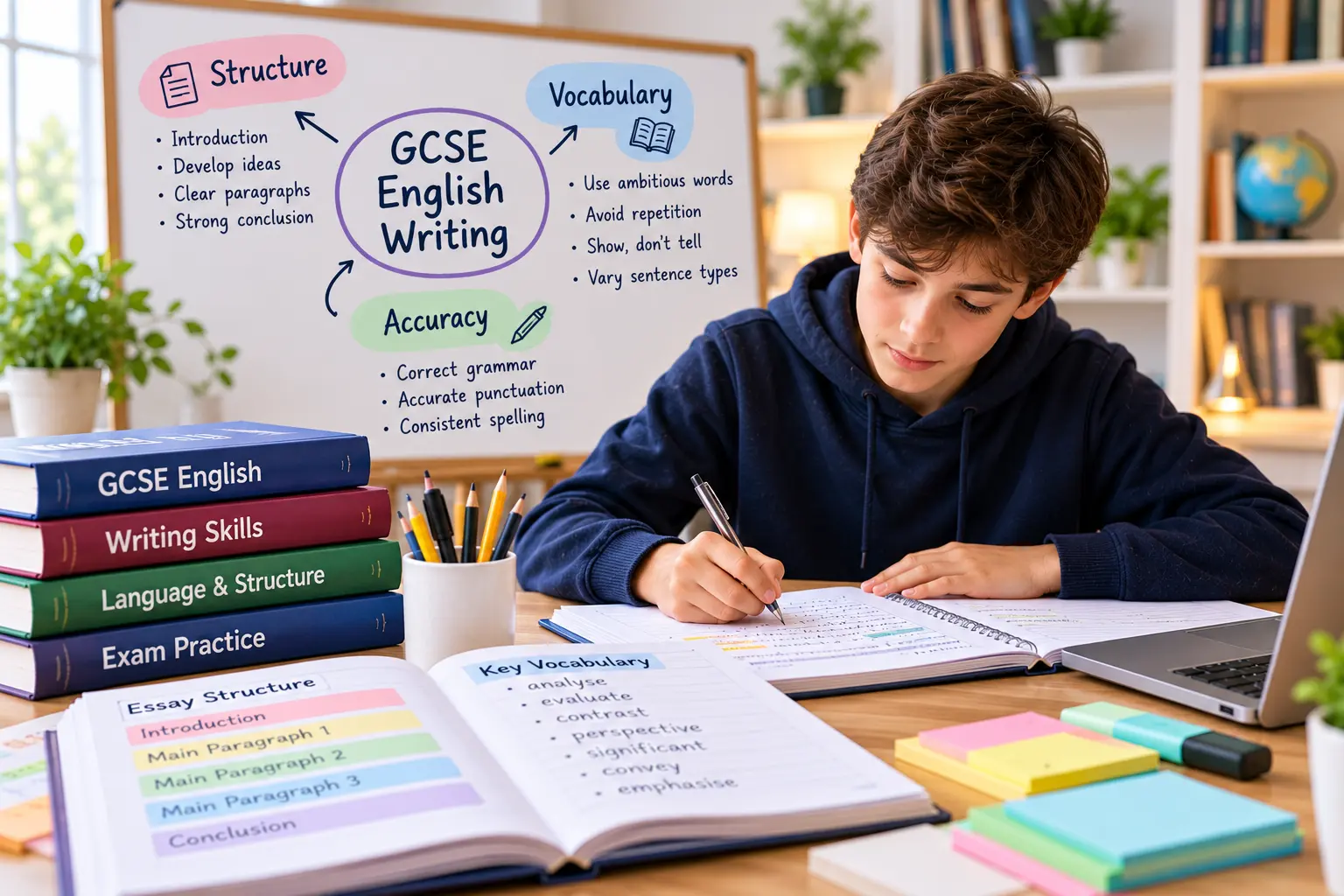
To improve GCSE English writing, students should focus on clear paragraph structure, varied vocabulary, accurate grammar and effective punctuation. Regular practice, careful proofreading and understanding exam requirements can help students communicate ideas more clearly and develop stronger writing skills.
GCSE English writing questions test more than a student’s ability to write long answers. Students must communicate ideas effectively, organise information and choose language suitable for the task, audience and purpose.
Depending on the exam board and question, students may need to write a descriptive piece, a story, a speech, an article, a letter or another form of non-fiction.
Before writing, identify three important things:
Understanding these requirements helps students make better decisions about tone, vocabulary and structure. A GCSE English tutor online can also help students understand different question types and practise applying these skills under exam conditions.
Good structure makes writing easier to follow. Even strong ideas can lose their impact when they are presented without a clear order.
Spend a few minutes planning your response. Note your main ideas and decide how they will develop from the introduction to the conclusion.
For a persuasive article, a simple plan might include:
For creative writing, consider the setting, characters, atmosphere and sequence of events instead.
Each paragraph should have a clear purpose. Start with a main idea, develop it with explanation or examples, and connect it to the overall response.
Avoid writing one very long paragraph. Equally, do not split every sentence into a separate paragraph without a clear reason.
Use linking words such as ‘however’, ‘therefore’, ‘for example ‘, and ‘in contrast’ where they help connect ideas naturally.
A wider vocabulary allows students to express ideas more precisely. However, using complicated words simply to impress an examiner can make writing unclear or unnatural.
Instead of repeatedly using words such as ‘good’, ‘bad’, ‘nice ‘, or ‘big’, choose alternatives that communicate your exact meaning.
For example:
The best choice depends on the context. Students should focus on accuracy and meaning rather than replacing every simple word with a more advanced one.
Reading newspaper articles, short stories, novels and opinion pieces introduces students to different writing styles.
Keep a vocabulary notebook and record unfamiliar words, their meanings, and example sentences. Practise using a few new words in your own writing each week.
This approach helps build vocabulary that students can use confidently in examinations.
Accuracy is an essential part of effective writing. Frequent errors can interrupt the reader’s understanding, even when the ideas themselves are strong.
Focus on these common areas:
Practise writing sentences of different lengths. Short sentences can create emphasis, while longer sentences can develop complex ideas. The aim is to use each sentence type effectively.
Students should practise both creative and transactional writing, depending on their GCSE specification.
For creative writing, focus on descriptive details, atmosphere, character development and a clear sequence of events. Show emotions through actions and observations rather than explaining every feeling directly.
For transactional writing, such as articles, speeches and letters, focus on audience, purpose, tone and persuasive techniques. Rhetorical questions, repetition, facts and direct address can strengthen an argument when used appropriately.
Practising different formats helps students become more flexible and prepared for unfamiliar examination questions.
Proofreading helps identify mistakes that may be overlooked while writing.
Leave a few minutes at the end of a practice task to review your response. Check spelling, punctuation, grammar, and paragraph organisation.
Read each sentence carefully and ask:
Keep a record of recurring mistakes. Reviewing these patterns allows students to focus their practice on the areas that need the most improvement.
Some students understand grammar rules but struggle to apply them in timed examinations. Others need support with planning, vocabulary, creative writing or interpreting questions.
English online tutoring can provide structured practice, personalised feedback and guidance on specific writing weaknesses. Students can review model answers, practise examination questions and learn how to improve their responses step by step.
A GCSE English tutor online can also help students understand assessment objectives, manage their time and develop a consistent approach to writing tasks.
Your Personal Tutor can support learners by helping them strengthen their writing skills, address individual learning gaps and practise with greater confidence.
Improving GCSE English writing takes regular practice, clear planning and attention to detail. By developing stronger structure, expanding vocabulary and improving grammatical accuracy, students can make their writing clearer and more effective.
With consistent effort, constructive feedback and suitable guidance from Your Personal Tutor, learners can build the skills and confidence needed to approach GCSE English writing tasks more successfully.
Start by practising paragraph structure, sentence accuracy and planning. Complete short writing exercises regularly, review feedback and focus on correcting repeated mistakes rather than trying to improve everything at once.
Read a variety of texts, maintain a vocabulary notebook and practise using new words in context. Focus on precise, appropriate language instead of memorising complicated words without understanding their meaning.
Punctuation helps communicate meaning, separate ideas and control sentence structure. Accurate punctuation makes writing clearer and supports effective communication.
Aim to practise several times a week if possible. Combine short exercises focusing on specific skills with occasional full, timed examination questions.
Online tutoring can help students identify weaknesses, receive individual feedback and practise examination techniques. Progress depends on the student's starting point, consistency, effort and the quality of the support provided.






We provide practical education that prepares you with real-world skills for lasting success.
Quick Links
Your Personal Tutor© 2026 All Rights Reserved. Design by Vivid Digisolution