
October 22, 2026
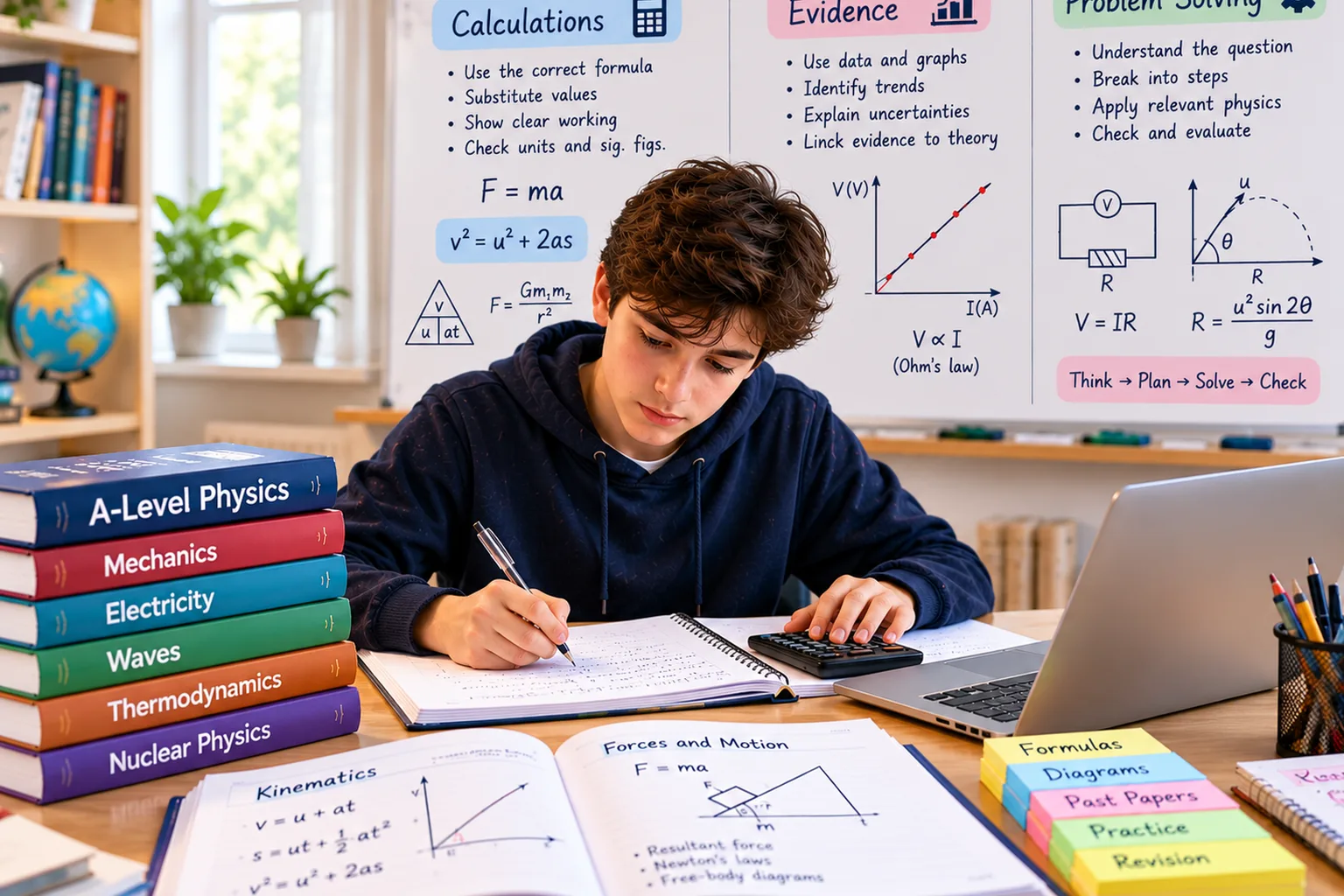
A-Level Physics becomes easier when students understand the principles behind each question, select the correct equations, show their working and interpret evidence carefully. Regular practice, clear explanations and structured problem-solving techniques can improve accuracy and confidence. Support from an A-level physics tutor online can also help students identify weaknesses, strengthen their understanding and prepare effectively for exams.
A-Level Physics requires more than remembering formulas. Students must understand how physical principles work and apply them to different situations. Topics such as mechanics, electricity, waves and fields often involve several connected concepts.
For example, when studying motion, students should understand the relationship between displacement, velocity, acceleration and time. This makes it easier to recognise which equations apply to a particular problem.
Start by reviewing the theory behind each topic. Create short notes explaining important definitions, laws and relationships. Then practise questions that gradually increase in difficulty.
If a concept remains confusing, revisit the explanation rather than repeatedly attempting questions without understanding the underlying principle.
Students who need help with foundational topics can also benefit from a GCSE physics tutor online before progressing to more demanding A-Level concepts.
Calculations are an important part of A-Level Physics exams. Even when students understand the theory, they may lose marks through incorrect substitutions, missing units, or mathematical errors.
A structured method makes calculations easier to manage.
Read the question carefully and write down the quantities provided. Look for values such as mass, velocity, time, resistance, or potential difference.
Convert quantities into appropriate SI units where necessary. For example, convert centimetres to metres or minutes to seconds before using an equation.
Determine exactly what the question asks you to calculate. Underline the required quantity or write it separately to keep your working focused.
Choose an equation that connects the known quantities to the unknown value. Understanding the physical relationship is more reliable than trying to memorise every possible question pattern.
Write the equation first, rearrange it if necessary, and then substitute the numerical values.
For example, if a 2 kg object accelerates at 3 m/s², Newton’s second law gives:
F = ma
F = 2 × 3 = 6 N
The resultant force is 6 newtons.
Include the correct unit and consider whether the answer is physically reasonable. Check the number of significant figures and whether your calculation matches the question’s requirements.
Showing clear working can also help examiners award method marks, even if the final answer contains an arithmetic error.
A-Level Physics assesses how well students interpret evidence, evaluate experiments and draw logical conclusions. These skills are particularly important in practical-based questions.
Evidence may include measurements, tables, graphs, observations or experimental results. Students should learn to distinguish between what the data demonstrates and what they assume it demonstrates.
For example, when investigating how current changes with potential difference, students might record several measurements and plot a graph. The graph can reveal a relationship between the variables and help identify whether the results support the expected model.
When answering evidence-based questions:
Students should also understand the difference between accuracy, precision, repeatability and reproducibility. These terms describe different aspects of experimental reliability and should not be used interchangeably.
When evaluating an experiment, explain how a proposed improvement would make the results more reliable or reduce uncertainty.
Some A-Level Physics questions combine multiple topics. A problem might require students to apply conservation of energy before using an equation of motion.
Instead of immediately searching for a formula, break the question into smaller steps.
First, identify the physical situation and the principles involved. Next, determine which information is available and what must be calculated. Work through the problem in a logical order, checking each intermediate result before moving forward.
Diagrams can be especially useful for questions involving forces, circuits, fields or wave behaviour. Label known quantities clearly and include relevant directions where appropriate.
If a question appears unfamiliar, relate it to the underlying principles you already understand. Exam questions often test familiar physics in a new context, so flexible thinking is more useful than memorising model answers.
Regular practice helps students recognise common question structures and identify areas requiring further revision.
However, simply completing large numbers of questions is not enough. Students should review their answers carefully and understand why mistakes occurred.
Keep a mistake log divided into categories such as:
Use this log to guide revision sessions. Reattempt incorrect questions after reviewing the relevant concept, rather than immediately checking the solution.
Timed practice papers are also valuable because they help students manage exam time and become familiar with question wording.
Some students need individual explanations to understand difficult topics, while others require support with calculations, practical questions or exam technique.
An A-level physics tutor online can provide structured lessons, work through challenging problems and give feedback on written answers. Personalised sessions can focus on the student’s weaker areas instead of spending equal time on every topic.
Online tutoring also allows students to revisit difficult concepts, practise exam-style questions and discuss mistakes in detail.
For younger students, a GCSE physics tutor online can help establish strong foundations in forces, electricity, energy and waves. These fundamentals can make the transition to A-Level Physics more manageable.
Your Personal Tutor can help students develop a more organised approach to learning, practise problem-solving techniques and build confidence through targeted academic support.
Success in A-Level Physics depends on understanding concepts, approaching calculations systematically, evaluating evidence accurately and practising problem-solving regularly. Students should focus on understanding their mistakes rather than simply memorising answers.
With consistent revision, exam-style practice and the right academic guidance, students can strengthen their scientific reasoning and approach challenging questions with greater confidence. Your Personal Tutor offers an opportunity to build these skills through focused learning and personalised support.
Practise identifying known quantities, selecting equations, substituting values correctly and checking units. Review mistakes to understand whether they result from weak concepts, mathematical errors or incorrect equation selection.
Evidence helps students evaluate scientific explanations, interpret experimental results and support conclusions using measurements. It also demonstrates their understanding of practical investigations and scientific reasoning.
Identify the relevant physical principles, write down the available information and divide the problem into smaller steps. Use diagrams and equations where appropriate, then check whether your answer is reasonable.
Yes. Online tutoring can provide personalised explanations, guided calculation practice, feedback on exam answers and support with difficult concepts. Regular independent practice remains essential for progress.
Yes. GCSE concepts such as energy, forces, electricity and waves provide the foundation for more advanced study. Revisiting these topics can help students understand A-Level material more confidently.






We provide practical education that prepares you with real-world skills for lasting success.
Quick Links
Your Personal Tutor© 2026 All Rights Reserved. Design by Vivid Digisolution