
July 21, 2026
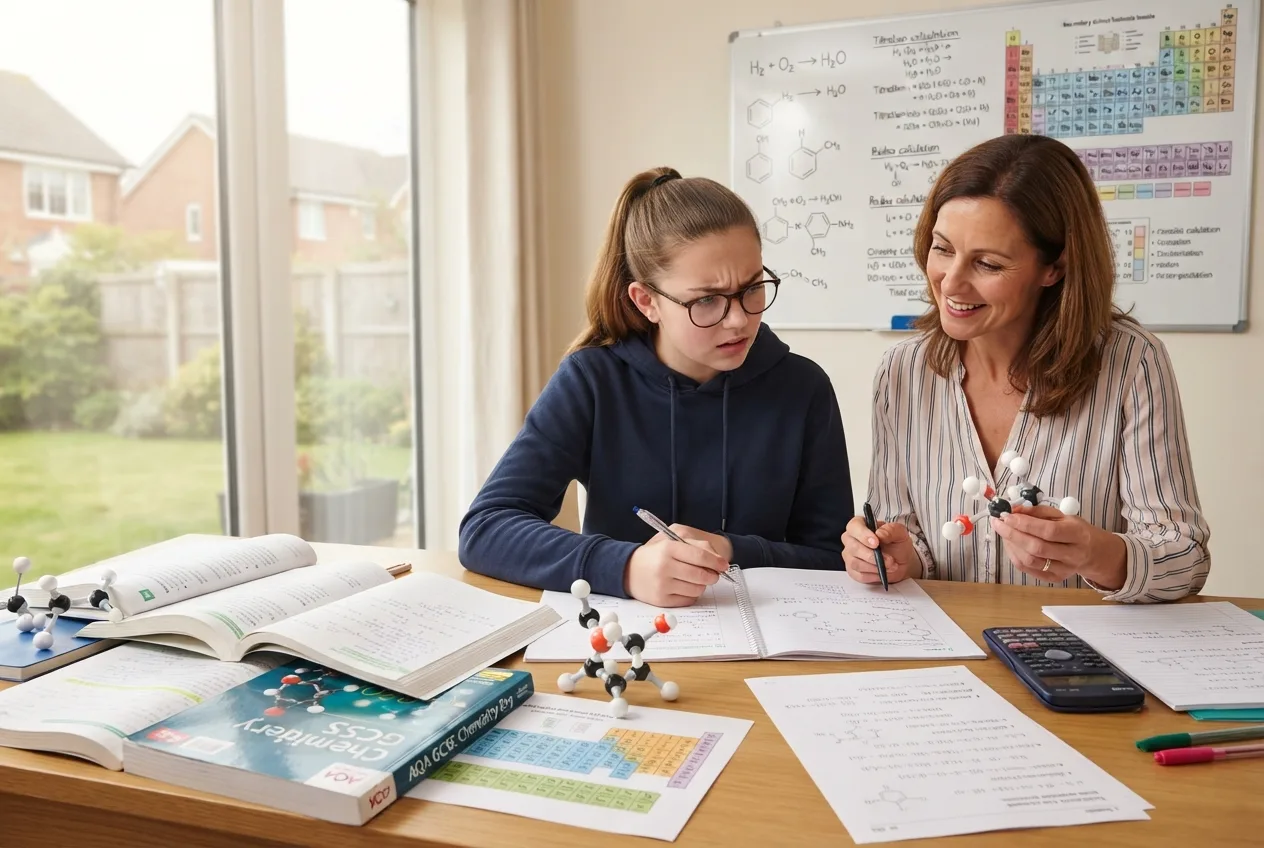
Chemistry is one of the most fascinating subjects in science, yet it is also one of the subjects that many students find difficult. From understanding atoms and molecules to solving complex equations, chemistry requires students to combine scientific knowledge with mathematical and analytical thinking.
Many students perform well in other subjects but struggle when studying chemistry. Understanding the reasons behind these challenges can help students, parents and teachers find effective ways to improve learning and build confidence.
Chemistry is different from many other school subjects because it combines theory, calculations, and practical application.
Students are expected to understand concepts that cannot be seen with the naked eye, such as atoms, ions, and molecular structures. This often makes chemistry feel abstract and confusing.
Challenge | Impact on Learning |
Abstract concepts | Difficult to visualise |
Mathematical calculations | Creates confusion and anxiety |
Large amount of content | Students feel overwhelmed |
Exam pressure | Reduces confidence |
Limited practice | Weak understanding of concepts |
One of the biggest reasons students struggle is that chemistry is not only a science subject.
Many chemistry topics involve mathematical calculations, data interpretation, and problem-solving skills.
Students who find mathematics difficult may also struggle with:
This combination of science and mathematics often makes chemistry seem more challenging than biology.
Chemistry often requires students to understand things that cannot be directly observed.
Concepts such as atomic structure, electron arrangement and chemical bonding can feel difficult because students cannot physically see them.
This makes visual learning techniques and diagrams extremely important.
Many students struggle to understand concentration and solutions because the ideas are highly conceptual.
Visualising concepts often makes chemistry easier to understand and remember.
GCSE and A-Level Chemistry contain a wide range of topics.
Students are expected to understand:
Trying to learn all these concepts at once can feel overwhelming.
One common mistake is focusing only on memorisation.
Chemistry requires understanding rather than simply remembering facts.
Students who memorise information without understanding how concepts connect often struggle to apply knowledge in examinations.
Understanding why reactions happen is usually more important than memorising definitions.
Some topics consistently cause difficulties for students.
Understanding protons, neutrons, isotopes, and electron configurations can be challenging.
Students often struggle to understand how atomic structure influences chemical behaviour.
Ionic, covalent, and metallic bonding introduce many new concepts.
Students need to understand not only definitions but also how these concepts affect chemical reactions.
Organic chemistry is often considered one of the most difficult topics.
It introduces:
Many students find the amount of information difficult to manage.
Calculations are one of the biggest challenges in chemistry.
Students frequently struggle with formulas, units, and mathematical problem-solving.
GCSE Chemistry introduces many new scientific ideas.
Students move from basic science concepts to more advanced topics that require analytical thinking and mathematical understanding.
Common GCSE challenges include:
Many students also underestimate the amount of revision required.
A-Level Chemistry is significantly more advanced than GCSE.
Students are expected to develop deeper scientific understanding and stronger problem-solving skills.
Topics become more detailed and mathematical.
A-Level students often struggle with:
This is why many students seek additional support during A-Level studies.
Confidence plays an important role in academic performance.
Many students begin to believe they are “not good at chemistry” after struggling with a few topics.
This lack of confidence can lead to:
Building confidence is therefore just as important as improving knowledge.
Chemistry examinations require students to do much more than remember information.
Students must:
This combination makes chemistry exams particularly challenging.
Exam pressure can also make students forget information they already know.
Practice is one of the most effective ways to improve chemistry performance.
Completing exam questions helps students:
Regular practice also improves familiarity with different question styles.
Many chemistry concepts become easier when students use diagrams and visual explanations.
Mind maps, models, and animations can make abstract ideas easier to understand.
Students should ask questions such as:
Understanding concepts deeply leads to better long-term performance.
Improving mathematical confidence often improves chemistry performance.
Students should regularly practise:
Parents play an important role in supporting learning.
Simple actions can make a significant difference.
Parents can help by:
Avoiding unnecessary pressure is also important.
Students perform better when they feel supported rather than criticised.
Every student learns differently.
Some students need more visual explanations, while others benefit from additional practice questions.
Personalised learning allows teaching methods to be adapted according to individual needs.
This often leads to:
Benefit | Outcome |
Individual support | Better understanding |
Flexible pace | Reduced stress |
Immediate feedback | Faster improvement |
Confidence building | Greater motivation |
Many students benefit from working with an online chemistry tutor.
One-to-one support allows tutors to identify weaknesses and explain difficult concepts in a personalised way.
An online chemistry tutor can help students:
Students studying multiple science subjects may also benefit from support from an A-level physics tutor online, particularly because chemistry and physics share many mathematical concepts.
Breaking revision into smaller sessions makes learning more manageable.
Consistency is usually more effective than long study sessions.
Past papers help students understand:
They also improve confidence before examinations.
Explaining concepts to another person is an excellent way to test understanding.
If students can teach a topic clearly, they usually understand it well.
Students should never feel afraid to ask questions.
Seeking clarification early often prevents confusion from becoming a bigger problem later.
Students often struggle because chemistry combines scientific concepts, mathematical calculations, and abstract ideas.
Chemistry requires analytical thinking, problem-solving, and understanding concepts that cannot easily be visualised.
This depends on the student. Many students find chemistry more difficult because it involves more calculations and abstract concepts.
A-Level Chemistry includes advanced topics, mathematical concepts, and complex problem-solving requirements.
Regular practice, strong revision techniques, and personalised support can significantly improve performance.
Yes. Personalised support often helps students understand difficult topics and build confidence.
Mole calculations combine chemistry concepts with mathematics, which many students find challenging.
Yes. Students who feel confident are more likely to participate, ask questions, and attempt difficult problems.
Consistent weekly revision is usually more effective than last-minute studying.
Understanding concepts, practising questions, and receiving personalised support are often the most effective strategies.
Chemistry can feel difficult because it combines science, mathematics, and abstract concepts. However, struggling with chemistry does not mean a student cannot succeed.
With the right study methods, regular
practice and support, students can improve their understanding and develop greater confidence.
Whether through independent study or guidance from an online chemistry tutor, personalised support can help students overcome challenges and achieve long-term academic success in chemistry.






We provide practical education that prepares you with real-world skills for lasting success.
Quick Links
Your Personal Tutor© 2026 All Rights Reserved. Design by Vivid Digisolution